Key Details
- Status Operational
- Availability Commercial Research Student project
- Test Types Angled pull Horizontal pull
- Max Object Length (metres)6
- Max Object Width (metres)0.8
- Max Weight (ton)1
- Pull Load (ton)40
- Break Test (ton)40
- Measurement Elongation control/ meas.
- Outputs Load diagrams
- General Third party accreditation Video documentation Customized test programs
Test Facility Description
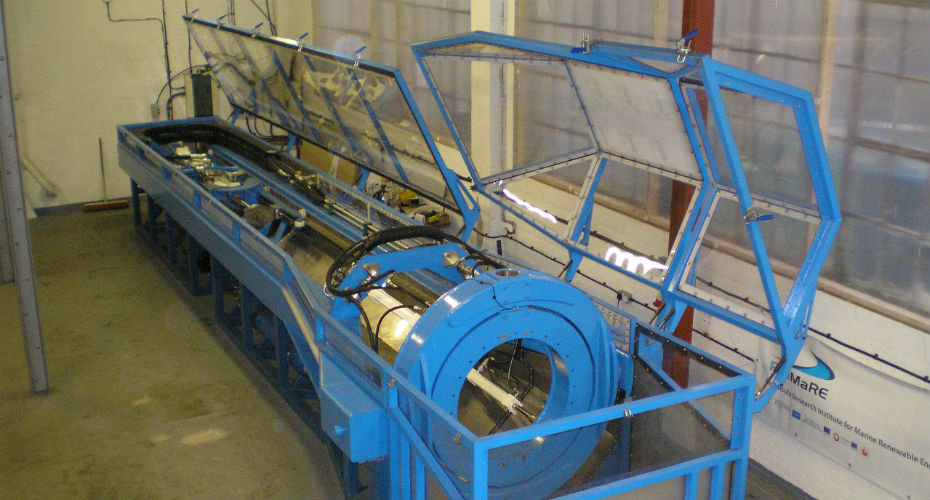
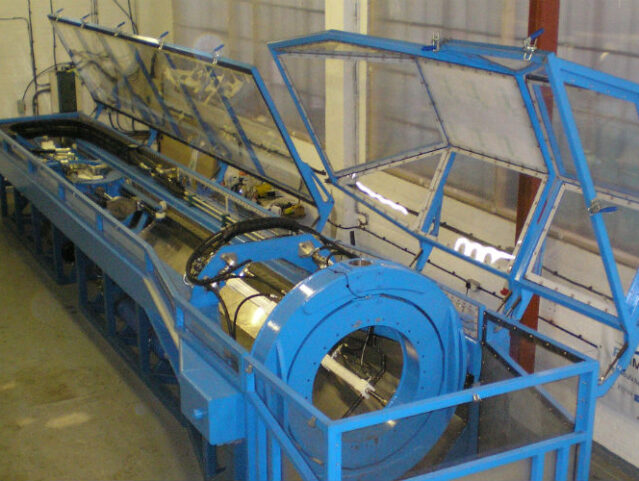
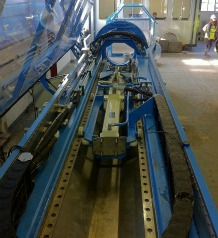
The Dynamic Marine Component (DMaC) test facility is a purpose built test rig that aims to replicate the forces and motions experienced by marine components in offshore applications. The test facility is based within the Renewable Energy Research Group of the University of Exeter at Penryn Campus, Cornwall.
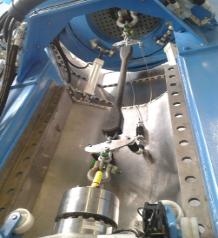
The test rig consists of a linear hydraulic cylinder at the tailstock that applies the tension and compression forces or displacements. At the other end of the rig, the headstock with three degrees of freedom can apply bending moments (torque) and angular displacements. The combination of forces and motions from the headstock and tailstock simulate the loads and displacements experienced by a floating body. The working principles are illustrated in figure 1 below. For example, the tailstock can replicate heave motion (Z) and the headstock can replicate pitch (Øx), roll (Øy) and yaw (Øz) motions.
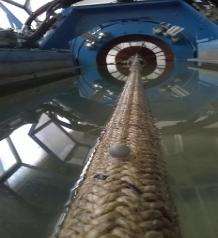
The rig is capable of replicating dynamic tensile forces up to 20 tonnes, static tensile forces up to 40 tonnes, and displacements up to 1 m. The maximum bending angle at the headstock is ±30º for pitch and roll with up to 10 kN·m of bending moment. The maximum torque or yaw is 10 kN·m with an infinite rotational displacement. Beyond that, the rig has the unique feature that components can be submerged in fresh water to allow testing in a wet environment. These features allow dynamic testing of large-scale components under controlled conditions with realistic motion or load characteristics.
This unique combination of features have allowed the DMaC test facility to support studies in to a variety of marine components including: conventional mooring ropes, compliant mooring components, subsea power cables, bend restrictors for power cables, aquaculture components, power take off devices for MRE and even acoustic monitoring of components. These studies are commonly part of national and international collaborative projects and are used to inform performance characterisation, peak or fatigue load assessment, reliability studies and accelerated test campaigns. Furthermore, test work has been conducted to international standard.